Sunday, October 30, 2011

We Visited Leh – Part III – In and around Leh


What my wife had to say about the trip to Leh

The trip to Leh was my husband’s idea – planned and executed totally by him for the rest of us. With my crazy work schedule, all I knew before we left was the date of departure and arrival. Leh is a phenomena we have not experienced before during our travels either in India or abroad. The sheer vastness of the landscape, the grandeur of the towering mountains, the isolation and solitude, the endless stretch of rough roads hewn into rock, the breathless (literally) view of mountains against blue skies and the warmth of the Ladakhis will forever be etched in our memories. We had a lot of laughter and fun but I think each one of us also found a certain peace and silence within ourselves that tends to get lost in the noise and bustle of city life. I now understand why sages and saints go to the Himalayas to search for spiritual truths- given time, even simple folk like us could, I think, find ourselves. For me personally, a few things stand out- the solitude and beauty, the exhilarating paragliding experience, the feeling of being so high up in the mountains. This trip also brought home to us what tough lives our jawans lead in high altitude areas. A trip to Leh must be on each person’s bucket list –a must see, once in a lifetime experience.

04th Oct 2011– In and around Leh

After leisurely breakfast we went sightseeing around Leh. Our first halt was the ‘magnetic Hill’. To experience the magnetic power you have to place your vehicle on a specific spot (Local authority has put up a bill-board to identify the place) and switch off the vehicle. Soon you will notice the vehicle starts moving.


At the magnetic hill
The spot where the car should be stopped
The next stop was to see the Sangam - confluence of Indus & Zanskar Rivers


Figure 1 - Indus is to the Left joined by Zanskar from the top at Sangam and flowing to Pakistan. Really breath taking.


Figure 2 - Strange formations near the sangam

After a long drive we reached 11th century Alchi Choskor, the oldest surviving monastic heritage of Ladakh - a UNESCO listed heritage site. The village of Alchi is situated on the left bank of the Indus, about 70 km from Leh, on Leh-Srinagar highway. It is not visible from the main road, and it is couple of km across the bridge on the Indus.


Figure 3 - Section of the Monastery


Figure 4 - Prayer wheels
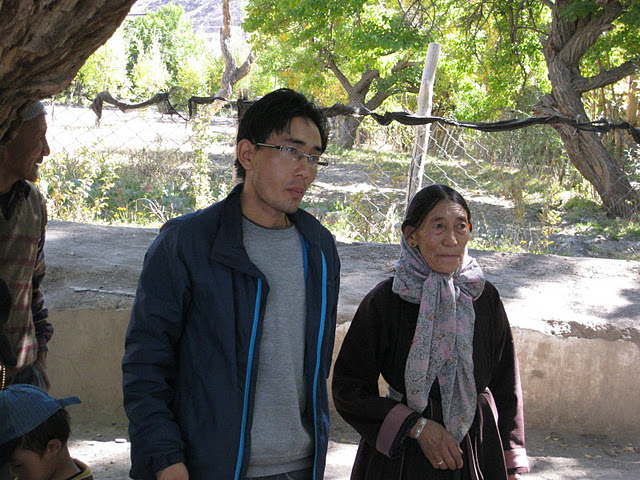

Figure 5 - Local Ladhaki


Figure 6 - Child full of cheer


Figure 7 - After a lovely vegetarian lunch

We then went to visit the famous ‘Gurudwara Pathar Sahib’constructed in the memory of Guru Nanak, about 25 miles away from Leh, on the Leh-Kargil road, 12000 ft above sea level. The Gurudwara was built in 1517 to commemorate the visit to the Ladhak region of Guru Nanak Dev, the founder Guru of the Sikh faith. During his lifetime Guru Nanak travelled to many distant places and one such place was Ladhak. Guru Nanak is well respected by Buddhists who consider him a saint. The Gurudwara is now maintained by the Indian Army.


Figure 8 - Impression of Guru Nanak in stone


Figure 9 - Section of the Gurudwara


Figure 10 - Yours truly


Figure 11 - Photo op at the historic National Highway 1

We then proceeded to Kali Mata, Temple of Guardians in Spituk monastery. The monastery contains 100 monks and a giant statue of Kali (unveiled during the annual Spituk festival).


Figure 12 - A view of the Spituk Monastery


Figure 13 - A section of the monastery


Figure 14 - Leh airport - viewed from the monastery

Our last visit for the day was ‘Hall of fame’ in Leh which was set up by the Indian Army XIV Corps as a Museum cum Memorial to the War Heroes. It is billed as a "Museum of Ladakh Culture and Military Heritage" and houses a War Memorial as well. The ‘Hall of Fame’ is a reminder to all of us of the great acts of courage and sacrifice made by the personnel of the Indian Army to keep India safe from external aggression. Reading the details of the recapture of ‘Tiger Hill’ at 0800h on 08 Jul 1999 is enough to enthuse every Indian to a new patriotic high.

The ultimate sacrifice by young Capt Vijayant Thapar, age 22, who died trying to evict Pakistani intruders from a ridge in Kargil on 28 June 1999 – just before he died he wrote to his father

“…..I have no regrets; in fact even if I become a human again, I will join the Army and fight for the nation…..

After his death, his father Col VN Thapar wrote “Your actions will forever inspire generations of Indians to come. You have left us with pride for being the parents of a worthy son and a lifetime of pain for having lost a child we love.

I could not control my feelings. Tears welled up in my eyes and when I looked around, there was not a single dry eye amongst us. Amidst the disillusioning specter of the likes of people like Kalmadi, Yeddyurappa, Raja and others of the same ilk - Capt Vijayant Thapar stands out as a symbol of hope and all that is noble in India. May his soul rest in peace.

Another poignant episode displayed in the ‘Hall of Fame’ is ‘Memories of Rezang La’. It was the site of the famous last stand of the Ahirs of 'Charlie' Company of the 13 Kumaon during the Indo – China war in 1962. C Company was led by Major Shaitan Singh, who posthumously won a Param Vir Chakra for his actions. In this action, 114 Ahirs out of a total of 123 were killed.

The caption reads “When Rezang La was later revisited dead jawans were found in the trenches still holding on to their weapons... every single man of this company was found dead in his trench with several bullet or splinter wounds. The 2-inch mortar man died with a bomb still in his hand. The medical orderly had a syringe and bandage in his hands when the Chinese bullet hit him... Of the thousand mortar bombs with the defenders all but seven had been fired and the rest were ready to be fired when the (mortar) section was overrun." Major General Ian Cardozo – extracts from his book ‘Param Vir, Our Heroes In Battle’


Figure 15 -  'Hall of Fame'


Figure 16 - A sand model depicting various passes, rivers, roads etc of the area

We returned home thereafter.


Monday, October 24, 2011

We Visited Leh - Part II - Khardung La

Trip to Khardung La – 3rd Oct


As we had to travel a short distance to see Khardung La, all of us took it easy and after a leisurely breakfast we set out to be a part of another historic moment. We also dressed up little more than usual to combat the cold and especially the biting wind.


Khardung La (meaning the ‘Pass of Lower Castle’ ) is situated 39 km by road from Leh. The first 24 km, as far as the South Pullu check point, are paved. From there to the North Pullu check point about 15 km beyond the pass the roadway is primarily loose rock, dirt, and occasional rivulets of snow melt. However, this pass is in better repair than many of the surrounding passes (Tanglang La, for example).


Khardong La is historically important as it lies on the major caravan route from Leh to Kashgar in Chinese Central Asia. In the yester - years about 10,000 horses and camels used to take the route annually.


Post 1962 war with China and subsequent skirmishes with Pakistan, the entire area has become militarily very sensitive. The Indian Army is present in large numbers all along the route to the pass and beyond.


On reaching the pass, all that I could do was to take a few photographs and visit a local tea shop to have Cinnamon Tea. At 18,358 ft one has to exercise extreme care to conserve energy. Too much of talking and moving about can be tiring , simple tasks like getting out of the car, bending down can drain your energy. Act your age is the thumb rule.


Quickly we descended and returned to Leh and spent the better part of the day having Ladhaki lunch, strolling on the streets and shopping for souvenirs.


I bought a Golf hat, a commemorative ceramic palate and a hip flask all of them loudly proclaim having traversed the highest motorable road in the world.


Having reached 18,358 ft, we ended our high altitude adventure – this will probably remain the highest altitude I will ever reach in this life.

At Last

I understand that the mountains are growing 2CM every year

Nazeer is showing something

Tasted Cinnamon tea

Not at all energetic

Let us go back after this photo

Offered our prayers to all those who work here

Another View

Some Details

Beginning to snow

Local Hero

Back to the car

Saturday, October 22, 2011

We Visited Leh - Part II - Pangong Tso

Trip to Pangong Tso – 2nd Oct

Having completed one day in house arrest, we were all rearing to go out the next day. Xylo driven by Nazeer arrived exactly at 8AM and all of us embarked the vehicle for our trip to Pangong Tso, located about 150 Km from Leh.
Wiki - Pangong Tso (or Pangong Lake; Tso: Ladakhi for lake) is an Endorheic Lake (a closed drainage basin that retains water and allows no outflow to other bodies of water such as rivers or oceans. ) in the Himalayas situated at a height of about 4,350 m (14,270 ft). It is 134 km (83 mi) long and extends from India to Tibet. 60% of the length of the lake lies in China. The lake is 5 km (3.1 mi) wide at its broadest point. During winter the lake freezes completely, despite being saline water.

The water is brackish and does not support any life. The sand on the bank of the lake is definitely the variety one finds on beaches. Understand that a number of fossils have been found in the vicinity of the lake.

Geologically, the origin of the Himalayas is the impact of the Indian tectonic plates traveling northward at 15 cm per year to impact the Eurasian continent, about 40-50 million years ago. The formation of the Himalayan arc resulted, since the lighter rock of the seabeds of that time were easily uplifted into mountains. An often-cited fact is that the summit of Mount Everest is made of marine limestone. Pangong Tso was also created due to the same geological phenomenon.

The roads are in good condition and we were able to reach Pangong Lake around noon. Once again we enjoyed the beauty of Himalayas – the ever changing landscape, sun playing tricks with the shadow and different hues of the rock face. Suddenly from nowhere the crystal clear deep blue of the lake hits you – you stand motion less in total amazement and awe. The sudden appearance of the lake is almost mystical. The colour, sheer vastness and the location of the lake amongst imposing mountains is sufficient to mesmerize any visitor. I had read a lot about the lake – but, what I saw was something awesome and inspirational – I was speechless and really did not know what to say. The beauty of the lake is so pure and serene – immediately a sense of calm and peace descends upon you.

We spent close to two hours basking in the glory of god and his creation.

We then proceed to the Army canteen and were treated to an excellent lunch of hot Rice, Rajma, sabzi and chapattis, courtesy 603 EME Battalion.

On the way back to Leh we stopped at 212 EME field workshop for tea and snacks. We got to view the Indian Army at close quarters.


An excellent and imposing view of Shey Palace -1
Greenery around Leh - 2


As we start the climb towards the lake - 3

The landscape is amazing - 4
 
The valley below - 5

The roads we traversed - mark the Z - 6

Some snow capped mountains  - 7
 
Chang la shrine - 8

Photo op with the gang - 9

Photo with the snow backdrop - to be shown to the neighbours - 10
 
The depth of the valley is simply amazing - 11


Another view of the landscape - 12

The browns continue to dominate - 13

Browns with a little bit of Grey - 14

All of a sudden the mystical blue appears from nowhere - 15
As much as I could capture - 16

From a different angle -17

With a brown backdrop - 18

Different views - 19
  
A historic moment for me - an achievement indeed!! - 21

Displaying a sense of satisfaction - 22


Poonam too excited for words - 23

Chits too is extremely happy and contended - 24


Birds resembling Seagulls have started visiting the lake since last 4 years - 25
A grand view of the lake - 26

A long view of the lake - 27
From another angle - what a view - 28


The Red is unimaginable - 30
 
The lake playing tricks with colour - 31
Creating stone formations for longevity of near and dear ones

A view from the army run canteen - 32
The Indian Army sums up the requirement for all - 33

On the way back - notice the sudden change in the landscape - 34
Local wild horse grazing  -36


The intersection with the old silk route.Roads leading to Pakistan and Zanskar - 37

Old habits die hard - 38

One of her requirements met - 40
Why miss the chance - In fact there was no snow as we went up - 41

Back again at Chang la - 17,586 ft - 42

With the Commanding Officer of 212 EME Field Workshop - 43

Leh by night -44

A lovely crescent shaped moon over the Army Mess -45
We returned to 603 EME battalion mess totally satisfied with what we saw.A miracle of nature - reminding us of a very distant past when continents were separated and life did not exist on earth.Standing face to face with Pangong lake was a mystical experience - another reminder how great nature is.