All of us
were really excited to see Madrid, as it happened to be our last place of visit.
In 14 days, we had gone around Spain and Portugal and travelled almost 3000 KM
in a bus. The journey to Madrid was accompanied by rain and snow fall. Unusual,
for this time of the year. The weather was really cold and we were prepared for
it, this time around. Cold weather somehow manages to heighten ones mood and
people become active and chirpy.
The travel
with ‘Trafalgar’ is a different kind of experience. On the plus side – it is meticulously
organized, time management is first-rate, choice of hotels is good and the
transport and the guides are excellent. Trafalgar covers a lot of ground and we
were able to see many cities in the duration of 14 days. David Nadal did a
creditable job as our tour director. However the coverage of the cities needs a
lot of tweaking. Our stay in Barcelona and Valencia could have been better handled.
Most of the good places of visit are covered under ‘Optionals’ for which one has
to pay extra.
Going on
your own with time on hand is undoubtedly the best way to travel. Our trip to
Greece with Nair and Sudhi was excellent. We visited Athens and Santorini. With
Athens as base we went to Delphi, three islands cruise and places around Athens.
I suppose, it largely depends on the country one visits – it’s better to go on an
organized tour in China – may be the same holds good when you visit Vietnam and
Cambodia.
Whichever
way one decides to travel, the bottom line should be –travel extensively. It
breaks monotony, you stand to gain knowledge and return wiser. I personally
feel that travel makes you a better person.
Spain and Portugal took us to a different Europe.Only when you travel you realize how vastly different countries in Europe are, in spite of their small size and closeness.'I visited Europe' makes absolutely no sense.One has to further qualify by saying Greece,Italy or Denmark - the same holds good with India. We are very vast and each state is different.I think there is nothing wrong in people demanding a separate state to enhance their identity - be it Telengana,Gorkhaland,Vidharba etc

Figure 1 - Drive up to Madrid
Finally we
reached Madrid and moved into a very stylish hotel ‘Novotel Madrid Puente De La
Paz’. The inner lobby immediately catches your attention. A series of wall
paintings and well appointed furniture makes up the place.

Figure 2 – The painting in the recess gives
an additional appeal

Figure 3 – A well appointed sitting area

Figure 4 – Cannot keep the bull away

Figure 5 -
Senora with a bull

Figure 6 – An excellent anteroom to wind
down after a hectic day
Madrid is the capital of Spain and its
largest city. The population of the city is roughly 3.3 million. The city
is located on the Manzanares River. We
went on a city tour in the afternoon. The city is full of parks, trees and
avenues. The central part of the city is very pretty and well preserved. The
rest of the city is modern with brick and cement structures. Madrid was once a
village and it was very common then for farmers to take their cattle for a walk
in the centre of the town. One can see the cattle paths even today. The city
was founded by the Muslims in the 9th century. In the 16th
century palaces were built to attract the nobility. Finally the capital moved
from Toledo to Madrid. The city population has grown from a meager 20.000 to
600,000 inhabitants to become one of the best destinations in Europe.
When the clock tower in Madrid strikes at midnight on the new Year eve 31st Dec - people in Madrid eat 12 grapes for 12 gongs.This event is show on all TV channels.Imagine millions of people eating grapes at the same time.

Figure 7 – Plaza de Espana
In the
center of the plaza is a monument to Spanish novelist, poet and playwright Miguel
de Cervantes saavedra, designed by architects Rafael Martínez Zapatero and
Pedro Muguruza and sculptor Lorenzo Coullaut Valera. The tower portion of the
monument includes a stone sculpture of Cervantes, which overlooks bronze
sculptures of Don Quixote and Sancho Panza. Next to the tower, there are two
stone representations of Don Quixote's "true love", one as the simple
peasant woman Aldonza Lorenzo, and one as the beautiful, imaginary Dulcinea
Toboso.

Figure 8 – Bronze sculptures of Don Quixote and Sancho
Panza. Dore and Lalitamma – Many memories.
After i had taken this photograph,Dore walked up to me and said 'I will always cherish this photograph".He thereafter went on to recollect a piece of family history. This is what he had to say
"When we were all appreciating the huge & impressive statue of Don Quixote, I recalled the contribution of my late father D.V.Seshagiri Rao,Professor & Author, in making this unique character known to Kannada readers. Apart from some original work to his credit,he added translations of a few well known works from a couple of other languages to the Kannada literary wealth. Included in this was, his translation of Don Quixote by CerVantes. Pity not a copy is available now. But, if I remember right, published sometime in early 50s. He didn't know Spanish.Obviously, he translated from an English translation; but am not sure which one was it, as it appears, there are more than one.
Instead of giving the usual title ' Don Quixote ' he chose " Ailuveerana Sahasagalu".Roughly meaning " The Adventures of a crazy warrior ". I believe the book was well received. In fact, after reading his Kannada translation,I was tempted to read the English version also.It is no easy job to bring out in a translation, the nuances and unique features of the original work with the same effect. But, my father,instead of resorting to literal translation,brought out the essence and typical characteristics of the hero, I believe, in a telling way appealing to the Kannada readers. Evidently, a lot of effort on his part.Watching the statue was really a nostalgic as well as a memorable event.
A truly remarkable achievement
After i had taken this photograph,Dore walked up to me and said 'I will always cherish this photograph".He thereafter went on to recollect a piece of family history. This is what he had to say
"When we were all appreciating the huge & impressive statue of Don Quixote, I recalled the contribution of my late father D.V.Seshagiri Rao,Professor & Author, in making this unique character known to Kannada readers. Apart from some original work to his credit,he added translations of a few well known works from a couple of other languages to the Kannada literary wealth. Included in this was, his translation of Don Quixote by CerVantes. Pity not a copy is available now. But, if I remember right, published sometime in early 50s. He didn't know Spanish.Obviously, he translated from an English translation; but am not sure which one was it, as it appears, there are more than one.
Instead of giving the usual title ' Don Quixote ' he chose " Ailuveerana Sahasagalu".Roughly meaning " The Adventures of a crazy warrior ". I believe the book was well received. In fact, after reading his Kannada translation,I was tempted to read the English version also.It is no easy job to bring out in a translation, the nuances and unique features of the original work with the same effect. But, my father,instead of resorting to literal translation,brought out the essence and typical characteristics of the hero, I believe, in a telling way appealing to the Kannada readers. Evidently, a lot of effort on his part.Watching the statue was really a nostalgic as well as a memorable event.
A truly remarkable achievement

Figure 9 – Statue of a bear and a mulberry
tree at the Puerta Del Sol Square

Figure 10 – On the day we were in Madrid
there was a big football match between Germany and Spain.
German supporters are in yellow. The
atmosphere was electric with the square reverberating with noise, shouting, catcalls
and the rest. Smell of beer was omnipresent.

Figure 11 – A very trendy shop

Figure 12 – Meet the meat

Figure 13 – Police ready for any eventuality
after the football match

Figure 14 – Part of the inner city

Figure 15 – A beautiful square

Figure 16 – Part of old Madrid. Cannon marks
are still visible on the wall.

Figure 17 – Modern city image

Figure 18 – Sky Scrapers of Madrid

Figure 19 – A very imposing government
building

Figure 20 - Public parks adorn the city
Toledo. Next morning we visited Toledo. It
is known as the "Imperial City" for having been the main venue of the
court of Charles I, and as the "City of the Three Cultures", having
been influenced by a historical co-existence of Christians, Jews and Muslims. It
is also known as ‘City of Tolerance’. Toledo is very famous for its steel. Toledo
steel, known historically as unusually hard and has been a traditional
sword-making, steel-working center since about 500 BC, and came to the
attention of Rome. Soon, it became a standard source of weaponry for Roman legions.
Toledo water in which the steel is tempered gives it the unusual strength.

Figure 21 – Cheers to Toledo

Figure 22 - Toledo’s Alacazar palace now
houses a museum of military history

Figure 23 – City of Toledo

Figure 24 – City square

Figure 25 – View of the church
The
cathedral has four entrances – one each for the King, nobility, the rich and
finally for the common people.

Figure 26 – Where ever one goes the windows
steal the show
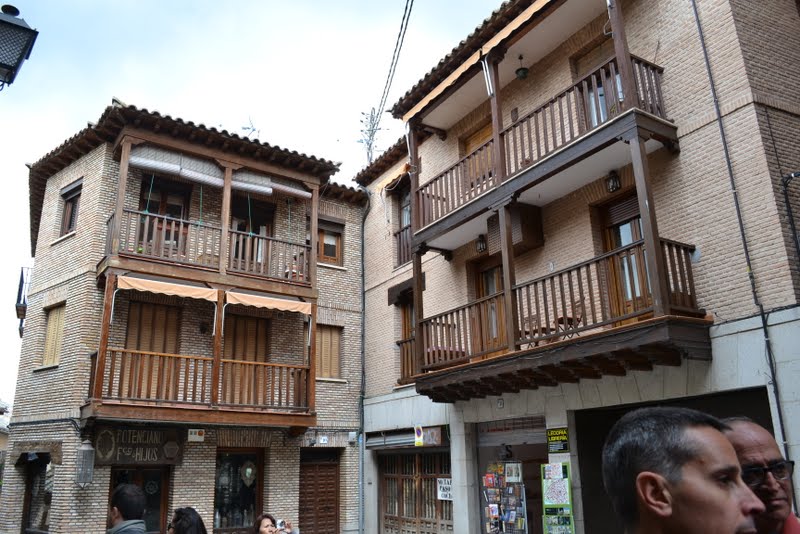
Figure 27 – Another example

Figure 28 – Yet another square

Figure 29 - The city straddles
the Maumee River

Figure 30 – A very clean walkway

Figure 31 – Sanctum Sanctorum

Figure 32 - The Smiling Virgin in the
Cathedral of Saint Mary of Toledo, Spain

Figure 33 - Vaulted ceiling, high altar, and Reja
of the main chapel

Figure 34 - The retable of the Cathedral of Toledo
is an extremely florid Gothic altarpiece; it is one of the last examples of
this artistic style.

Figure 35 - El Transparente
One of the most outstanding features of
the Cathedral is the Boroque altarpiece called El Transparente. Its name refers
to the unique illumination provided by a large skylight cut very high up into
the thick wall across the ambulatory behind the high altar, and another hole
cut into the back of the altarpiece itself to allow shafts of sunlight to
strike the tabernacle

Figure 36- Jai enjoying the morning

Figure 37 – Nuns making marzipan
Marzipan is a confection consisting
primarily of sugar or honey and almond, sometimes augmented with almond oil or
extract. It is often made into sweets; common uses are marzipan-filled chocolate
and small marzipan imitations of fruits and vegetables. According to one
version, marzipan was invented by
nuns of the Convent of
San Clemente in Toledo.
The Convent
supposedly came up with this delectable stuff in the 16th century, when there
was a famine on. Almond trees grow like weed in and around Toledo, so the nuns
ground up the almonds, mixed them with sugar, and hey presto – marzipan.

Figure 38 – Some are tired, some lost in
their own thoughts, others confused and the rest waiting for the beer time

Figure 39- Remotely operated stumps to keep
the tourist vehicles away. The local have electronic remote to lower them
We went to
a local restaurant to spend the last night of our stay in Spain. The wine and
food was excellent.

Figure 40 – A befitting closure to our long
trip

Figure 41 – Kats and Nair with an heightened
sense of overall well being and happiness.

Figure 42 - Madrid–Barajas Airport is the
main international airport. Departures – Terminal 4.
Finally we bid good bye to Madrid on 02 May 3013